Top 10 Types of Composite Rebar FRP for Global Buyers
Choosing reinforcement for an international project is rarely a simple material decision. Composite Rebar FRP can resist corrosion, reduce handling weight, and support longer service life in demanding environments. Yet performance depends on resin quality, fiber direction, surface treatment, temperature, and installation practice.
Antonio Nanni, a leading FRP-reinforced concrete researcher, has often emphasized, “FRP reinforcement is not a replacement for steel; it is a different material with different properties.” That distinction matters. Global buyers should compare glass FRP, carbon FRP, basalt FRP, aramid FRP, and hybrid systems carefully. Product shape also matters, including ribbed bars, sand-coated bars, helically wrapped bars, molded bars, and prestressing tendons.
Small details matter.
A bar may look identical to another product, yet behave differently under sustained loads or elevated temperatures. Buyers should review certified tensile strength, elastic modulus, bond performance, creep data, alkali resistance, and dimensional tolerance. They should also verify independent testing, traceable production records, and installation guidance.
This guide examines ten major types of Composite Rebar FRP used across bridges, marine structures, parking decks, tunnels, utilities, and industrial floors. The comparison focuses on practical selection, not marketing claims. Some categories overlap, and that can be confusing. A hybrid bar may combine material benefits while introducing new inspection questions.
No single FRP bar fits every project. That is the uncomfortable part. Design codes, climate exposure, fire requirements, shipping conditions, and contractor experience can change the preferred choice. Careful buyers should question impressive numbers and request evidence behind them.
What Composite FRP Rebar Is and How Its Structure Works
Composite FRP rebar is a reinforcement bar made from continuous fibers and a polymer resin. The fibers carry tensile loads, while the resin binds them and protects them from moisture, salts, and chemicals. Common types include glass, carbon, basalt, and aramid fiber composites.
Its structure is easier to understand through a cut section. Long fibers run along the bar, like tightly aligned threads in a rope. A resin matrix surrounds them. The outer surface usually has helical ribs, grooves, or a sanded coating for concrete bonding. ACI 440.1R-15 reports typical GFRP tensile strengths between 600 and 1,000 MPa. Its elastic modulus is commonly 35–60 GPa, far below steel. That difference matters.
FRP bars also weigh about one-quarter as much as steel, according to Federal Highway Administration technical literature. Workers can carry longer lengths across a bridge deck, but cutting still requires suitable tools and dust control. The bar does not rust, yet it can lose strength under high temperatures and ultraviolet exposure before installation. Composite reinforcement is not steel with a better finish. It behaves differently. Engineers must check creep, bond, fire resistance, and serviceability under ACI 440 and relevant ISO testing procedures. A practical weakness remains: field damage or poor anchorage can be overlooked because the bar looks intact.
Ten Main Types of FRP Rebar by Fiber and Resin Composition
Top 10 Types of Composite Rebar FRP for Global Buyers
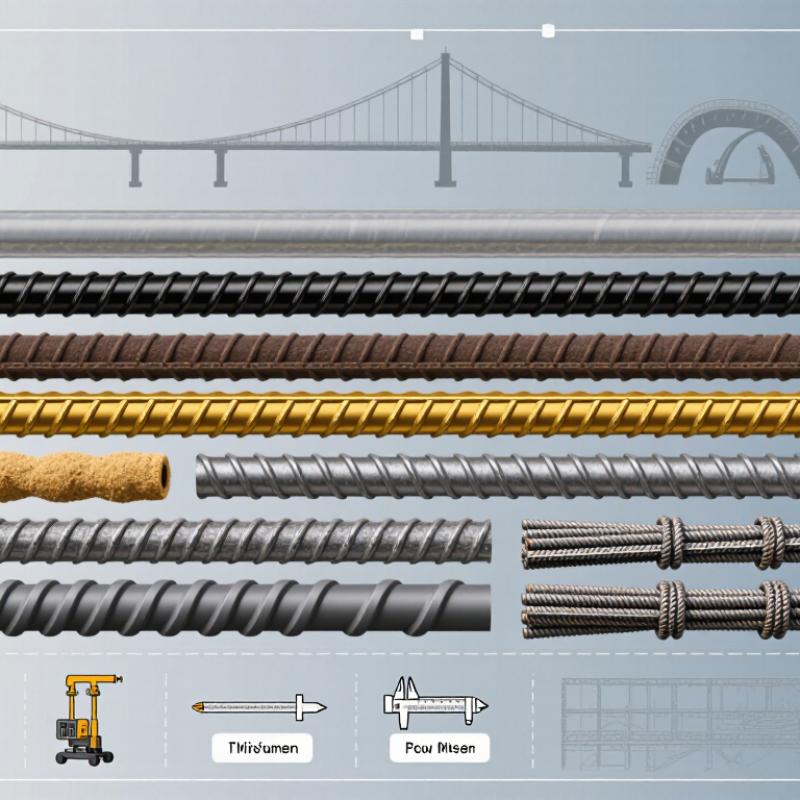
FRP rebar is classified mainly by fiber and resin composition. The ten practical combinations include glass fiber with epoxy, vinyl ester, or polyester resin. Carbon fiber commonly uses epoxy or vinyl ester resin. Aramid fiber pairs with epoxy or vinyl ester resin. Basalt fiber is available with epoxy, vinyl ester, or polyester resin.
Each combination behaves differently in construction. Glass fiber offers a balanced price and corrosion resistance for concrete slabs, retaining walls, and bridge decks. Carbon fiber provides high stiffness, but its cost may restrict large projects. Aramid fiber handles impact well, although its surface bonding requires careful evaluation. Basalt fiber can tolerate alkaline concrete, yet product consistency deserves close inspection.
Resin controls moisture resistance, chemical stability, and heat performance. Epoxy usually provides strong bonding and low shrinkage. Vinyl ester often suits aggressive moisture or chemical exposure. Polyester can reduce cost, but its long-term durability needs closer verification. A supplier should provide tensile data, bar diameter tolerance, fiber content, and test conditions.
Do not rank these materials by fiber strength alone. A stiff carbon bar may create handling challenges on a crowded jobsite. A lower-cost polyester system may perform poorly under severe exposure. Installation temperature matters too. Design assumptions can be wrong. Engineers should compare the actual concrete environment, anchorage length, crack control needs, and documented quality results before selection.
Performance Differences Among Glass, Carbon, Basalt, and Aramid Rebar
Composite rebar is not one uniform product. Its performance changes with fiber type, resin quality, surface profile, and manufacturing control.
The ten practical forms often include sand-coated GFRP, ribbed GFRP, pultruded CFRP, braided CFRP, BFRP, AFRP, glass-carbon hybrids, glass-basalt hybrids, helically wrapped bars, and molded composite dowels. GFRP offers strong corrosion resistance and moderate cost. It suits bridge decks, seawalls, and parking structures. Its elastic behavior demands careful crack-width design.
CFRP delivers the highest tensile strength and excellent fatigue resistance, but its purchase price can restrict large projects. Basalt rebar usually sits between glass and carbon in stiffness, cost, and temperature performance. It can be useful where alkalis, moisture, and moderate structural loads coexist. Aramid rebar is light, tough, and highly resistant to impact. However, designers must examine ultraviolet exposure and long-term creep. These differences matter.
Surface texture also changes bond behavior. Sand-coated bars may develop strong mechanical adhesion, while ribbed profiles can provide more predictable load transfer. Field inspections often reveal installation damage at bends and supports. Composite bars cannot be bent casually on site. They need approved shapes and controlled handling. Small details matter.
A practical selection should compare tensile capacity, elastic modulus, shear sensitivity, fire behavior, creep data, and verified test standards. Supplier documentation is useful, but independent testing remains wiser. I have seen specifications look impressive until temperature and anchorage conditions were checked. That is an uncomfortable lesson. No single FRP type performs best in every climate, span, or construction method.
How Global Buyers Should Compare FRP Rebar for Project Requirements
Global buyers should compare FRP rebar by project demands, not by material labels alone.
The main types include glass, basalt, carbon, and aramid fiber bars.
Ribbed, sand-coated, helically wound, hybrid, and prestressing profiles offer different bonding and strength behaviors.
The right choice depends on span, exposure, loads, temperature, and installation methods.
Start with design values, not catalog peak strength.
Ask for verified tensile data, elastic modulus, creep limits, thermal behavior, and alkali resistance.
Check whether testing follows recognized standards and reflects the intended bar diameter.
A coastal bridge may need stronger durability evidence than an indoor floor.
A tunnel project may prioritize fire performance and low smoke risk.
Small details matter.
Review the surface profile carefully.
Sand coating can improve bond, while molded ribs may simplify placement.
Compare lap lengths, bend restrictions, cutting tools, bar tolerances, and delivery capacity.
Field teams also need clear storage instructions.
Moisture, sunlight, and careless stacking can damage some products before installation.
A neat spreadsheet can still mislead.
Project engineers should compare total installed cost, not only the purchase price.
Carbon FRP may reduce bar size, yet its higher material cost can affect budget approval.
Glass FRP may be economical, but its lower stiffness could require wider sections or tighter spacing.
These trade-offs deserve independent structural review and documented calculations.
International Standards, Quality Checks, and Supplier Evaluation Criteria
Top 10 Types of Composite Rebar FRP for Global Buyers
International Standards, Quality Checks, and Supplier Evaluation Criteria
Composite rebar may use glass, basalt, carbon, or hybrid fibers in different resin systems. Each type behaves differently under tension, heat, moisture, and alkaline concrete. Global buyers should match the product with project exposure, not only with price. Relevant references may include ASTM D7957, ISO 10406-1, CSA standards, and ACI guidance. Requirements differ by market. Confirm the latest edition with the project engineer.
A reliable quality review starts with production records and independent test reports. Check nominal diameter, fiber volume, tensile strength, elastic modulus, bond performance, and alkali resistance. Inspectors should also review resin curing, surface texture, straightness, and batch traceability.
A small sample can reveal uneven ribs or resin-rich areas. Those details matter during concrete placement. Certificates alone are not enough. Ask whether testing used the same production line and final product design.
Supplier evaluation should include factory experience, process controls, complaint handling, and export packaging. Request samples from several batches, not one polished piece. Verify laboratory accreditation and test dates. Confirm storage instructions, delivery tolerances, and technical support for cutting or anchoring.
Some suppliers provide impressive data but weak field guidance. That is a warning. I have also seen buyers overlook temperature limits because the tensile value looked attractive.
Standards reduce uncertainty, but they do not replace engineering judgment. A careful review may still find gaps, and those gaps deserve written clarification before purchase.