
7 Tips for Choosing Glass Fiber Rebar
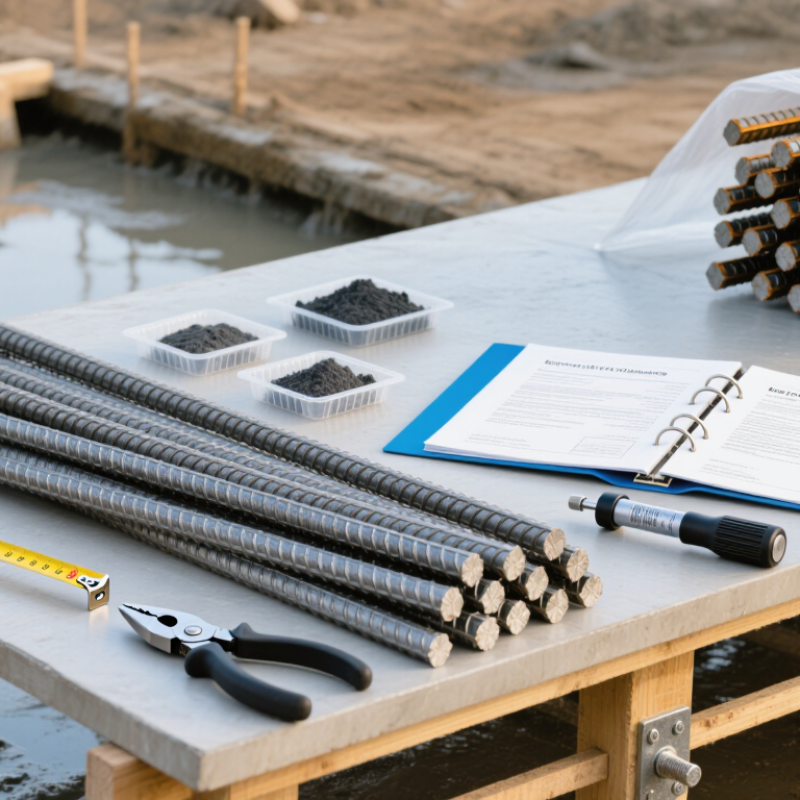
Choosing Glass Fiber Rebar requires more than comparing prices or reading a supplier’s brochure. On a real construction site, a bundle may sit beside wet concrete, tight formwork, and cutting tools. These conditions reveal whether the product is practical, consistent, and suitable for the project.
Glass Fiber Rebar offers corrosion resistance and a lighter handling weight than traditional steel reinforcement. However, it does not behave exactly like steel. Its tensile strength, bond performance, stiffness, and temperature response must match the design requirements. Engineers should review technical data, certification, manufacturing quality, and installation guidance before approving a product. Local project specifications and applicable building standards also matter.
Small details can affect the result. Check bar diameter and surface texture. Confirm whether workers can cut the bars without damaging their ends. Examine storage instructions, especially when materials remain outdoors. Ask how the manufacturer controls resin content and dimensional accuracy. A reliable supplier should provide traceable test reports, clear design support, and realistic performance information.
No single choice is perfect. That matters.
Some buyers focus too heavily on initial cost. This can overlook labor savings, corrosion exposure, and long-term maintenance needs. Others assume every fiberglass bar performs similarly. That assumption can fail when production quality varies. The following seven tips offer a practical framework for comparing products, questioning supplier claims, and selecting Glass Fiber Rebar with greater confidence. They also encourage a careful review of project conditions, because the cheapest option may not be the most dependable one.
Understanding Glass Fiber Rebar and Its Main Benefits
Glass fiber rebar is a non-metallic reinforcement made from continuous glass fibers embedded in a resin matrix. It strengthens concrete while avoiding the rust that can expand inside cracked steel-reinforced structures. This matters in bridge decks, parking areas, seawalls, and slabs exposed to moisture or deicing salts. The material is lightweight, so workers can carry long bars by hand. That can reduce lifting strain and installation time. It also does not conduct electricity, which suits selected electrical and transit projects.
Tip: Check the design loads, bar diameter, surface pattern, and required development length before purchasing. Glass fiber rebar usually has a lower elastic modulus than steel, so engineers may need different spacing or crack-control calculations. Do not treat it as a direct one-for-one replacement. That shortcut can create problems. Review the project drawings with a qualified structural engineer, especially where bending, anchoring, or fire exposure is important.
Tip: Inspect the bars at delivery. Look for crushed ribs, exposed fibers, resin damage, or inconsistent dimensions. Store them on supports above wet ground, and avoid sharp dragging across concrete or gravel. Cutting should follow the manufacturer’s technical guidance and site safety procedures. In my experience, handling errors are easy to overlook because the bars feel durable. They are not indestructible. A practical choice also considers local inspection requirements, installation training, concrete cover, and long-term exposure conditions.
| Tip | Selection Dimension | What to Check | Typical Technical Information | Main Benefit | Important Consideration |
|---|---|---|---|---|---|
| 1 | Application and Exposure | Identify whether the project involves bridges, marine structures, parking decks, wastewater facilities, foundations, or other chloride- and moisture-exposed concrete. | Glass fiber rebar is non-metallic and does not rust like conventional steel reinforcement. It is commonly considered where corrosion exposure is a major design concern. | Can help extend service life and reduce corrosion-related concrete repair. | It is not automatically suitable for every structural application. Design must follow the applicable engineering standard and project requirements. |
| 2 | Tensile Strength | Compare the manufacturer’s certified tensile strength with the required reinforcement design values, including the required safety factors. | Many commercially available GFRP bars report nominal tensile strengths roughly in the range of 600–1,200 MPa, depending on bar size, fiber content, and test method. | High tensile strength can provide effective reinforcement with a relatively lightweight bar. | GFRP is typically linear-elastic until rupture and does not yield like steel. Do not substitute it using steel yield-strength assumptions. |
| 3 | Elastic Modulus and Deflection | Review the elastic modulus and check crack width, deflection, span, and serviceability requirements—not only ultimate strength. | A common reported elastic-modulus range for GFRP is approximately 40–65 GPa, which is lower than the approximately 200 GPa modulus of steel. | The lower modulus can still provide corrosion-resistant reinforcement while supporting lightweight construction. | Concrete members reinforced with GFRP may require additional reinforcement or greater section depth to control deflection and cracking. |
| 4 | Bar Size, Surface, and Bond | Confirm the bar diameter, surface profile, rib or grit treatment, bond performance, minimum bend radius, and available straight or bent shapes. | GFRP bars are manufactured in multiple nominal diameters and may use sand-coated, helically wrapped, ribbed, or other surface treatments to improve concrete bond. | A suitable surface profile can improve load transfer and anchorage within the concrete. | Do not field-bend standard straight GFRP bars unless the product and procedure specifically permit it. Factory-made bends may be required. |
| 5 | Weight and Handling | Compare the bar’s unit weight, delivery length, cutting method, lifting requirements, and compatibility with the project’s installation process. | GFRP density is commonly about 1.9–2.1 g/cm³, compared with approximately 7.85 g/cm³ for steel. GFRP reinforcement is therefore often around one-quarter the density of steel. | Lower weight can simplify transportation, placement, and manual handling, potentially reducing installation effort. | GFRP can be damaged by improper storage, sharp impacts, or uncontrolled bending. Use approved cutting tools and protect bars from abrasion. |
| 6 | Electrical and Thermal Properties | Determine whether the structure requires electrical insulation, electromagnetic transparency, or compatibility with sensitive equipment. | GFRP is electrically non-conductive and non-magnetic. Its longitudinal coefficient of thermal expansion is commonly reported at approximately 6–10 × 10−6/°C, depending on the product. | It can be useful in rail, imaging, power, laboratory, and other applications where conductive steel reinforcement may interfere with equipment or signal performance. | Thermal behavior is direction-dependent and differs from concrete and steel. Temperature effects should be considered in the structural design. |
| 7 | Standards, Testing, and Quality Control | Request product test reports, dimensional tolerances, long-term durability data, lot traceability, installation instructions, and compliance with the project’s governing code. | Evaluation should include tensile properties, bond behavior, durability, creep-rupture performance, alkali resistance, and resistance to the project’s expected environmental exposure. | Verified data supports safer design, consistent installation, and more reliable long-term performance. | Published values are not interchangeable across products or test methods. Use design values and reduction factors required by the applicable standard. |
Related Posts
-

China Top 10 Fibre Glass Rebar Manufacturers in 2026
-

Top 10 GFRP Rebar Glass Fiber Material Suppliers?
-

What Is the Best China Glass Fiber Rebar?
-

How to Use Basalt Rebar for Strengthening Your Construction Projects?
-
2026 How to Use Fibre Glass Rebar for Stronger Construction Projects?
-
Why Is Basalt Rebar Becoming the Go To Choice for Construction Projects?