
Choosing high-performance GFRP rebar is not simply a matter of comparing tensile strength values. The right product must suit the concrete mix, exposure conditions, loading demands, and installation method. Engineers often begin with project drawings, then examine bar diameter, surface treatment, elastic modulus, bond performance, and durability data. A coastal bridge may require different protection from an indoor parking structure. Salt spray, freeze-thaw cycles, alkaline concrete, and ultraviolet exposure can influence long-term performance. Small details matter. A rough bar surface should provide reliable adhesion without creating installation problems. Field experience also shows that lighter reinforcement can simplify lifting, cutting, and placement, but only when workers understand the material’s behavior.
When evaluating High Property Gfrp Rebar, request independent test reports, production records, and clear compliance information. Check whether reported values represent guaranteed design properties or only laboratory averages. That difference is important. Review tensile strength, creep rupture, shear capacity, thermal expansion, and fire-related limitations with a qualified structural engineer. Supplier reputation matters, yet documents should support every major claim. Speak with contractors who have handled the product on real projects. Their feedback may reveal cutting dust, connector weaknesses, or unexpected bending restrictions. No checklist is perfect. A product can look impressive on paper and still perform poorly when specifications, detailing, or installation are unsuitable. Careful comparison, practical judgment, and transparent verification create a stronger basis for selecting GFRP reinforcement that remains dependable throughout the structure’s service life.
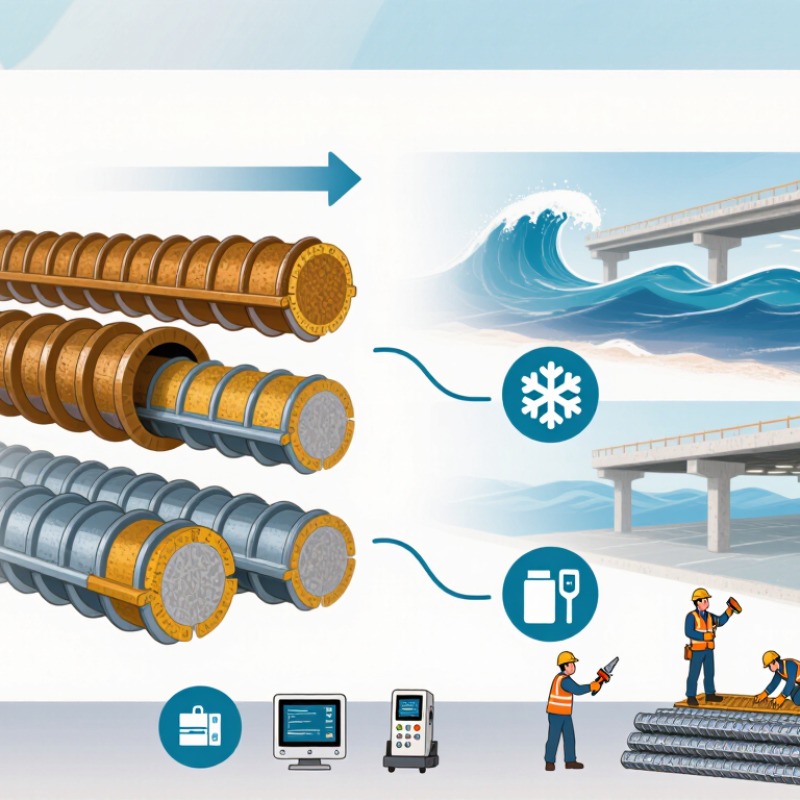
High-performance GFRP rebar is a composite reinforcement made from continuous glass fibers and a polymer resin. The fibers carry tensile loads, while the resin protects them and maintains their alignment. Unlike steel, GFRP does not rust when moisture, chlorides, or deicing salts reach the reinforcement. It is also lightweight, making manual handling easier on busy construction sites. Very useful in harsh environments.
“High-performance” means more than a high tensile-strength number. A reliable bar should offer consistent fiber content, strong surface bonding, accurate dimensions, and stable performance after environmental exposure. Ribbed or sand-coated surfaces can improve concrete adhesion. Engineers should review test data for tensile strength, elastic modulus, creep, and durability. Quality control matters at every stage, from production to site storage.
GFRP also behaves differently from steel. It remains mostly linear until sudden rupture, with little warning before failure. Its lower stiffness may increase crack widths or deflection in some designs. It can lose performance under excessive heat, and cutting requires proper dust protection. It is not a perfect steel replacement. Careful design is essential. In practice, selecting the right bar means checking loads, temperature, fire requirements, concrete cover, and applicable standards together. A stronger bar alone may still produce a poor structure.
How to Choose High Performance GFRP Rebar?
Selecting GFRP rebar requires more than checking tensile strength. Compare tensile capacity, elastic modulus, bond performance, and glass-transition temperature. A strong bar may still deflect excessively in a lightly reinforced beam. That detail is often missed.
Durability data should reflect the project environment. Review tests involving moisture, alkaline concrete, freeze-thaw cycles, and sustained loading. Ask for independent reports, test methods, and production quality records. Diameter tolerance and surface consistency also affect placement and concrete bonding. During site evaluations, installers often notice handling issues before engineers do. A bar that arrives scratched or uneven deserves investigation. I would not rely on one impressive number. Real performance depends on design assumptions, exposure, and installation quality.
Tips: Check long-term creep and fatigue results, not only short-term strength. Confirm the bar’s actual surface type and bond data. Match the thermal expansion behavior with surrounding concrete. Review fire performance for the complete structural assembly, because isolated material data can mislead. Request samples from regular production, not only laboratory batches. Keep a record of storage conditions and bending restrictions. Some selection decisions remain uncertain when project-specific evidence is limited, so document those assumptions clearly.
Use this comparison framework to evaluate GFRP rebar for concrete reinforcement. The numerical ranges are typical industry values and should be verified against the applicable project specification, design code, and certified test reports.
| Performance Factor | Why It Matters | Typical GFRP Rebar Data | What to Look for During Selection | Relevant Verification or Design Reference |
|---|---|---|---|---|
| Tensile Strength | GFRP rebar is strong in tension and is commonly used to control cracking and resist tensile forces in concrete. | Approximately 600–1,000 MPa, depending on bar diameter, fiber type, resin system, and manufacturing process. | Select a certified guaranteed tensile strength that exceeds the design demand after applying the required environmental and reduction factors. | ASTM D7205; ASTM D7957; CSA S807; project-specific structural design code. |
| Elastic Modulus | The modulus affects crack width, deflection, and reinforcement stiffness. GFRP has a lower modulus than steel, so serviceability often governs design. | Approximately 40–60 GPa for common glass-fiber-reinforced polymer bars. | Compare the guaranteed longitudinal modulus and perform crack-width and deflection checks rather than selecting solely by tensile strength. | ASTM D7205; ACI 440.11; CSA S806; applicable national design provisions. |
| Guaranteed Rupture Strain | GFRP reinforcement is generally linear-elastic until rupture and does not yield like steel. The strain value is therefore important for design and safety checks. | Typically about 1.2%–2.0%, calculated from tensile strength and elastic modulus. | Confirm the guaranteed strain and ensure that the design follows the required tension-controlled or compression-controlled failure provisions. | ASTM D7205; ACI 440.11; CSA S806. |
| Bond and Surface Profile | Reliable bond transfers force between the bar and concrete and limits slip, anchorage length, and crack spacing. | Surface configurations may include sand-coated, helically wrapped, ribbed, or molded profiles. Bond performance is product-specific. | Require documented bond testing, consistent surface geometry, dimensional tolerances, and development-length data for the selected bar. | ASTM D7913; ASTM D7957; CSA S807. |
| Durability in Concrete | Resistance to moisture, alkaline pore solution, chloride exposure, freeze-thaw cycles, and elevated temperature influences long-term reinforcement performance. | GFRP is non-corrosive in the conventional steel-rebar sense, but the resin, glass fibers, bond surface, and stress level still affect durability. | Request accelerated aging results and documented environmental reduction factors for the actual exposure class and design service life. | ASTM D7705; ACI 440.11; CSA S807; project durability specification. |
| Alkali Resistance | Concrete pore solution is highly alkaline. Poor resistance can reduce tensile capacity, stiffness, or bond over time. | Performance depends on the glass-fiber type, resin chemistry, cure quality, fiber sizing, and protective surface system. | Look for alkali-resistance test data and a documented retention of tensile strength and modulus after conditioning. | ASTM D7705; ASTM D7205; manufacturer-independent certified test reports. |
| Coefficient of Thermal Expansion | Thermal movement affects compatibility with concrete and can influence restraint stresses and crack behavior. | Typical longitudinal values are approximately 6–10 × 10-6/°C; transverse values are generally higher. | Use longitudinal and transverse thermal data where temperature changes, restraint, or composite behavior are important. | ASTM E831 or equivalent validated thermal-expansion testing; project design requirements. |
| Density and Handling Weight | Lower density reduces lifting effort, transportation weight, and manual handling requirements on site. | Approximately 1.9–2.2 g/cm³, compared with about 7.85 g/cm³ for carbon steel. | Confirm bar mass per metre, allowable coil or straight-bar lengths, storage requirements, and compatibility with the installation method. | Product dimensional and mass tolerances; project handling and safety plan. |
| Electrical and Magnetic Properties | GFRP is electrically non-conductive and non-magnetic, which can be valuable near sensitive equipment or where electromagnetic transparency is required. | GFRP does not provide the electrical conductivity of steel and generally has very low magnetic response. | Confirm the complete reinforcement assembly, including couplers, chairs, ties, and supports, meets the required electrical or magnetic criteria. | Project electromagnetic compatibility, electrical isolation, or non-magnetic construction requirements. |
| Temperature and Fire Performance | Polymer matrices can lose stiffness at elevated temperatures. Concrete fire exposure may require additional protection or a project-specific assessment. | Glass transition temperature and residual properties vary significantly with resin formulation and cure. No single temperature value applies to all GFRP bars. | Request glass-transition data, elevated-temperature test results, concrete cover requirements, and a fire-engineering assessment where applicable. | ASTM E1640 or equivalent thermal analysis; ACI 440.11 fire provisions; project fire code. |
| Bar Diameter and Dimensional Tolerance | Actual diameter, cross-sectional area, and surface geometry influence development length, spacing, lap zones, congestion, and concrete placement. | Nominal bar sizes are available across a broad range, but the effective cross-sectional area and outer profile are product-specific. | Check nominal area, measured dimensions, mass, straightness, rib or wrap geometry, and allowable tolerances against the design drawings. | ASTM D7957; CSA S807; approved shop drawings and inspection records. |
| Cutting, Bending, and Field Installation | GFRP bars cannot normally be field-bent like steel. Incorrect cutting or bending can damage fibers and reduce capacity. | Factory-made bends, hooks, and stirrups are commonly required. Field cutting should use suitable tools and follow the approved method. | Confirm bend availability, minimum bend diameter, cutting procedures, end protection, storage conditions, and installation training. | ACI 440.11; CSA S807; approved fabrication and installation procedures. |
| Quality Control and Traceability | Composite performance depends on fiber content, resin impregnation, curing, surface treatment, dimensions, and batch consistency. | Important records include batch number, production date, bar size, tensile properties, modulus, surface profile, and test results. | Require a quality-management system, lot-specific certificates, independent testing when appropriate, and traceable delivery documentation. | ASTM D7957; ISO 9001-based quality procedures; project inspection and testing plan. |
| Life-Cycle Value | Initial material cost is only one part of the decision. Reduced corrosion risk, lighter handling, and lower maintenance exposure can affect total project value. | Economic benefits depend on exposure conditions, design life, installation method, serviceability requirements, and local material availability. | Compare total installed cost, expected maintenance, design changes, transport, labor, inspection, and replacement risk over the project life. | Project life-cycle cost analysis; owner durability and maintenance requirements. |
Selection priority: Start with design strength and serviceability, then verify bond, durability, temperature performance, dimensional tolerances, installation requirements, and independent quality documentation. Typical values are indicative only; final selection must use certified data for the specific GFRP rebar and the governing design code.
Choosing high-performance GFRP rebar starts with the project, not the product. Match the reinforcement to structural loads, exposure, service life, and installation conditions. A parking deck near the sea may need stronger corrosion resistance than an indoor floor. A bridge deck also demands careful attention to temperature, cracking, and long-term deflection.
I compare the design tensile strength, elastic modulus, bar diameter, surface profile, and bond performance. These values must fit the engineer’s calculations and applicable building standards. GFRP does not yield like steel, so the design approach requires extra care. Check the required development length and lap details early. Small changes can affect congestion and concrete placement.
The environment matters greatly. Chlorides, moisture, chemicals, and freeze-thaw cycles can influence durability requirements. On site, I also inspect storage conditions, cutting methods, bar supports, and spacing. GFRP bars are lightweight, but careless bending or dragging may damage them. Keep them off the ground.
Ask for verified test data.
A certificate alone is not enough. Review test methods, batch traceability, and quality records with the design team. I have seen projects focus heavily on tensile strength while overlooking stiffness and crack control. That shortcut can create problems later. It is worth checking assumptions against actual construction details, because drawings may not reflect field constraints. When requirements remain uncertain, a qualified structural engineer should confirm the selection before ordering material.
How to Choose High Performance GFRP Rebar?
Quality begins with documented performance, not a glossy product sheet. Check whether the bars comply with ASTM D7957/D7957M and the design guidance in ACI 440.11-22. These documents address dimensions, tensile properties, bond, and quality control. ASTM D7957 specifies a minimum guaranteed tensile strength of 600 MPa for many GFRP bar grades, but strength alone is not enough. Review the elastic modulus, glass transition temperature, resin type, surface profile, and coefficient of thermal expansion. Small surface defects can affect concrete bond.
Demand independent test reports from accredited laboratories. Ask for recent batch results, not only old qualification data. FHWA technical guidance reports that GFRP reinforcement can reduce bar weight by roughly 75% compared with steel. That benefit matters during installation, especially on congested bridge decks. However, lighter bars do not automatically mean easier construction. Crews still need correct bending limits, cutting tools, storage methods, and lap details. I have seen specifications overlook these practical issues.
Supplier reliability requires traceability. Each delivery should identify the production lot, manufacturing date, bar diameter, and test results. Verify that the supplier can explain long-term durability under alkaline concrete, moisture, and temperature changes. ACI 440.1R-15 notes that GFRP design depends strongly on creep rupture and environmental reduction factors. This is where cheap documentation becomes risky. Visit the facility when possible, inspect packaging, and compare delivered dimensions with the approved drawings. Trust, but verify.
Choosing high-performance GFRP rebar requires more than comparing prices per meter. ACI 440.1R-15 reports GFRP density at roughly 1.5–2.0 g/cm³, compared with steel at about 7.85 g/cm³. A worker can carry longer bundles with less lifting equipment. That matters on remote bridge decks or tight urban sites. It does not automatically reduce labor costs. Crews still need approved cutting tools, careful spacing, and nonmetallic supports.
Installation details affect the budget. GFRP cannot be bent or welded on site like steel. Project teams must order bends early and protect bars from damage during concrete placement. The Federal Highway Administration’s technical guidance on GFRP bridge reinforcement highlights corrosion resistance and reduced maintenance exposure, but it also stresses design-specific checks. Lower stiffness can require larger bar sizes or tighter spacing for crack control. Bigger quantities may erase part of the initial labor advantage.
Long-term value depends on the exposure environment. ACI 440.1R-15 lists GFRP tensile strengths commonly above 600 MPa, while its elastic modulus remains lower than steel’s. Therefore, engineers should compare serviceability, not only strength. Life-cycle studies should include inspections, traffic disruption, repairs, and expected replacement intervals, following the cost principles in ISO 15686-5. The first invoice may look uncomfortable. That comparison is incomplete. A realistic estimate should use local labor rates, equipment access, design revisions, and a documented maintenance scenario. Some savings remain uncertain, and pretending otherwise weakens the decision.