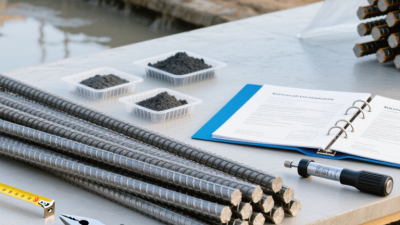
China’s GFRP rebar industry is moving from niche applications toward bridge decks, marine structures, tunnels, and corrosion-sensitive buildings. The shift is practical. Steel reinforcement can rust when chloride reaches the bar, while glass-fiber-reinforced polymer offers non-corrosive performance and lower weight.
Market evidence supports this direction. The MarketsandMarkets “Fiber Reinforced Polymer Rebar Market” report identifies infrastructure renewal, coastal construction, and corrosion resistance as major growth drivers. Grand View Research also reports expanding demand for fiber-reinforced polymer composites in construction. These reports indicate strong potential, but market estimates differ by methodology and regional coverage. That matters.
Performance must remain the priority. ACI 440.1R-15 provides design guidance for GFRP-reinforced concrete, while ASTM D7957 specifies requirements for solid round GFRP bars used in concrete reinforcement. These references help buyers examine tensile strength, modulus, surface treatment, resin quality, durability testing, and production consistency. They also remind us that supplier claims require verification.
This guide introduces China’s top 10 GFRP rebar glass suppliers, with particular attention to product capability, manufacturing experience, certifications, export service, and application suitability. Gfrp Rebar Glass By Fenghui is included for readers assessing dependable glass-fiber reinforcement options. The comparison is not based on advertising alone. Factory evidence matters.
No ranking is flawless. Public data can be incomplete. Buyers should still request test reports, batch records, technical drawings, and project references before selecting a supplier. A strong product should perform beyond the brochure, especially beside saltwater, under repeated loading, or inside a humid concrete slab. That is where real expertise becomes visible.

Glass fiber reinforced polymer (GFRP) rebar is a non-metallic reinforcement made from continuous glass fibers embedded in a polymer resin. Unlike steel, it does not rust when exposed to moisture, chlorides, or deicing salts. Its low weight also reduces handling effort on construction sites. A ten-meter bar can often be carried by one worker, depending on its diameter and design.
GFRP rebar helps extend the service life of bridge decks, parking structures, seawalls, tunnels, and water-treatment facilities. Engineers select it when corrosion risk is high and concrete cover is limited. It also has low electrical and thermal conductivity, making it useful near sensitive equipment or electromagnetic environments. However, its behavior differs from steel. GFRP usually has lower stiffness, so engineers must control deflection and crack width carefully. It also has limited resistance to high temperatures.
Installation needs discipline. Crews should avoid sharply bending factory-made bars or dragging them across rough ground. Damaged surfaces may expose fibers and reduce reliability. Accurate spacing, proper supports, and compatible concrete placement remain essential. Testing should confirm tensile capacity, bond performance, durability, and temperature resistance before approval. Design standards provide valuable guidance, but project conditions still require judgment. GFRP is not a perfect substitute for steel in every structure. Mistakes often come from treating both materials as interchangeable.
Evaluating China’s top GFRP rebar glass suppliers requires more than comparing prices. Material consistency should come first. ACI 440.1R-15 reports typical GFRP tensile strengths of about 600–1,000 MPa, while elastic modulus commonly ranges from 35–60 GPa. Ask suppliers to provide batch-level test records, not only a general brochure. Verify bar diameter, resin content, glass-fiber alignment, surface ribs, and curing temperature. Small production changes can affect anchorage and bending performance.
Durability evidence deserves equal attention. FHWA technical guidance highlights GFRP reinforcement’s resistance to corrosion, but concrete exposure, temperature, and alkaline conditions still require testing. Request results for alkaline resistance, freeze-thaw cycles, water absorption, and bond strength. ISO 10406-1 also provides relevant test methods for fiber-reinforced polymer reinforcement. Traceability matters. Each coil or bar bundle should carry a clear batch number, production date, and test reference. Useful support includes installation guidance and engineering calculations.
Production capacity can be misleading. A large workshop may lack stable quality control. Visit the facility, inspect pultrusion lines, and compare retained samples with delivered products. I would also check whether the supplier can maintain tolerance during long orders. That detail is often missed. No supplier is perfect, and published test data may not represent every shipment. Independent laboratory verification remains worthwhile, especially for bridges, seawalls, and chemically exposed structures.
China’s GFRP rebar sector is expanding with infrastructure renewal and corrosion-control projects. MarketsandMarkets’ 2024 FRP Rebar Market report estimates growth from about USD 220 million in 2023 to USD 390 million by 2028. That equals a projected compound annual growth rate near 12%.
A reliable top-ten supplier review should examine more than production volume. Buyers should verify glass-fiber type, resin formulation, rib geometry, tensile strength, and batch traceability. ASTM D7957/D7957M-22 provides performance requirements for solid glass-fiber-reinforced polymer bars. CSA S807-19 also supports structural design and material evaluation. These standards help separate engineering capacity from attractive marketing language.
The strongest Chinese suppliers usually provide continuous pultrusion lines, controlled resin mixing, and documented quality testing. Look for tensile data, elastic modulus results, bond testing, and ultraviolet exposure records.
Factory audits remain useful. Websites can overstate capacity.
A 2023 report from the China Association of Building Energy Efficiency highlights continuing demand for durable, low-maintenance construction materials. Yet supplier rankings remain imperfect because public production data is inconsistent. Some companies publish laboratory results without independent verification. That gap deserves attention.
Buyers should request recent test reports, project references, inspection records, and export documentation before comparing the final ten suppliers. Experiences from bridge decks, marine structures, and wastewater facilities often reveal more than brochures.
A capable GFRP rebar supplier is judged by more than catalog variety. Its product range should cover ribbed bars, mesh, stirrups, and custom lengths for bridge decks, seawalls, tunnels, and industrial floors. The Federal Highway Administration reports that GFRP reinforcement can weigh about 75% less than steel, while resisting corrosion in chloride-rich environments. That difference can simplify manual handling and reduce lifting equipment on site.
Manufacturing discipline matters more than marketing language. Continuous pultrusion, controlled resin impregnation, precise fiber alignment, and stable curing directly affect tensile strength and bond performance. A serious factory should record bar diameter, resin ratio, surface profile, batch number, and test results. ASTM D7957/D7957M provides requirements for solid circular GFRP bars, while ACI 440.11-22 supports structural design using GFRP reinforcement. These references give buyers a useful technical baseline.
Market position is harder to prove. Export volume alone is weak evidence. Delivery consistency, third-party testing, engineering support, and successful field use matter more. Industry forecasts published by MarketsandMarkets indicate double-digit growth for GFRP rebar demand through the late 2020s, driven by infrastructure durability concerns. Still, forecasts can overstate adoption. A supplier may offer competitive pricing, yet lack local design assistance or long-term performance records. That gap deserves attention. A transparent manufacturer should welcome factory audits, independent testing, and project-specific calculations before large orders.
Anonymized market benchmark based on publicly available product specifications, common international standards, and typical manufacturing capabilities in China.
| Rank | Anonymized Supplier Profile | Primary Product Scope | Glass Reinforcement | Typical Diameter Range | Typical Tensile Strength | Typical Elastic Modulus | Resin System | Production Capability | Common Compliance References | Typical Market Position |
|---|---|---|---|---|---|---|---|---|---|---|
| 1 | Supplier Profile A | Continuous GFRP rebar, stirrups, and custom cut lengths | E-glass roving; high fiber-volume formulation | 6–32 mm | 800–1,200 MPa | 45–60 GPa | Vinyl ester and epoxy | Multi-line pultrusion; automated surface forming; export packaging | ASTM D7957/D7957M; ISO 10406-1; CSA S807 | High-volume infrastructure and export projects |
| 2 | Supplier Profile B | GFRP reinforcement bars and mesh-compatible accessories | E-glass fibers with corrosion-resistant sizing | 4–25 mm | 700–1,100 MPa | 42–58 GPa | Vinyl ester | Medium-to-large batch pultrusion; standard lengths up to 12 m | ASTM D7957/D7957M; ACI 440.11; ISO 10406-1 | Established supplier for concrete durability applications |
| 3 | Supplier Profile C | Standard GFRP rebar for roads, bridges, and marine structures | Alkali-resistant E-glass reinforcement | 8–32 mm | 750–1,050 MPa | 40–55 GPa | Vinyl ester and modified polyester | Dedicated pultrusion cells; ribbed and sand-coated finishes | ASTM D7957/D7957M; CSA S807; ASTM C1557 test methods | Competitive option for corrosion-sensitive construction |
| 4 | Supplier Profile D | GFRP bars, dowels, and prefabricated reinforcement cages | Direct-roving E-glass | 6–28 mm | 650–1,000 MPa | 40–52 GPa | Epoxy and vinyl ester | Flexible production; custom bending and cutting capability | ISO 10406-1; ASTM D7957/D7957M | Strong fit for customized regional projects |
| 5 | Supplier Profile E | GFRP rebar for precast concrete and utility infrastructure | E-glass roving with controlled fiber alignment | 4–20 mm | 650–950 MPa | 40–50 GPa | Vinyl ester | Standardized high-repeat production; coil and straight-bar delivery | ASTM D7957/D7957M; ISO 10406-1 | Cost-focused supplier for repeat orders |
| 6 | Supplier Profile F | GFRP bars and rock-bolt reinforcement for industrial applications | High-strength E-glass | 10–32 mm | 700–1,050 MPa | 42–55 GPa | Vinyl ester and epoxy | Heavy-duty profiles; controlled curing and dimensional inspection | ISO 10406-1; ASTM D7957/D7957M | Niche supplier for demanding industrial environments |
| 7 | Supplier Profile G | GFRP reinforcement for coastal, wastewater, and chemical facilities | Alkali-resistant E-glass | 6–25 mm | 650–1,000 MPa | 40–55 GPa | Chemical-resistant vinyl ester | Surface ribbing and sand coating; batch traceability | ASTM D7957/D7957M; CSA S807 | Application-led supplier emphasizing corrosion resistance |
| 8 | Supplier Profile H | Small- and medium-diameter GFRP bars for residential and commercial work | E-glass roving | 4–16 mm | 600–900 MPa | 40–50 GPa | Vinyl ester | Short-run flexibility; standard straight lengths and coils | ISO 10406-1; ASTM D7957/D7957M | Responsive supplier for smaller construction orders |
| 9 | Supplier Profile I | GFRP dowels, bars, and reinforcement components for precast systems | E-glass with surface-treated fibers | 6–20 mm | 600–900 MPa | 38–50 GPa | Epoxy and vinyl ester | Component-oriented production; cutting, drilling, and packaging | ISO 10406-1; ASTM D7957/D7957M | Value-added component supplier |
| 10 | Supplier Profile J | Entry-level GFRP bars for general concrete reinforcement | Standard E-glass roving | 4–25 mm | 600–850 MPa | 38–48 GPa | Polyester and vinyl ester | Basic pultrusion lines; standard profiles and packaging | ISO 10406-1; ASTM D7957/D7957M | Price-sensitive supplier for non-specialized applications |
GFRP rebar is gaining attention in coastal bridges, parking decks, seawalls, tunnel linings, and utility slabs. Its glass fibers resist chloride-induced corrosion, while its low weight can simplify handling on congested sites. A 2024 market assessment by Grand View Research forecasts roughly 10% annual growth through 2030. Growth alone proves little.
Application controls the specification. For bridge decks, designers should examine crack width, concrete cover, fatigue, and freeze-thaw exposure.
In MRI rooms, nonmagnetic reinforcement can reduce equipment interference. GFRP also has a lower elastic modulus than steel, so deflection may govern design. That detail is often underestimated.
Quality checks should reference ASTM D7957/D7957M and ACI 440.11-22. These documents address bar properties, testing, and structural design. CSA S807-19 offers additional requirements for GFRP reinforcement materials and construction. Request third-party tensile, bond, alkali-resistance, and dimensional test results. Check batch traceability, resin consistency, rib geometry, and storage records. A practical supplier review should compare guaranteed tensile strength, glass-fiber content, coefficient of thermal expansion, and design values—not only price. FHWA technical guidance emphasizes documented durability testing for infrastructure exposure. Still, published test results may not represent local concrete, temperature, or installation conditions. Field validation remains wise. The cheapest option may become expensive.