What is Composite Reinforcement Gfrp Rebar and its Applications?
Composite Reinforcement GFRP rebar has gained significant attention in the construction industry. This innovative material offers unique advantages, particularly in environments prone to corrosion. Dr. Emily Carter, a leading expert in composite materials, once said, “GFRP rebar represents a breakthrough, combining strength with durability.”
The applications of Composite Reinforcement GFRP rebar are vast. It is particularly effective in bridges, parking garages, and marine structures. Its lightweight property simplifies transportation and installation processes. Furthermore, it performs exceptionally well under extreme conditions, ensuring longevity.
However, challenges remain. The cost of GFRP rebar can be higher than traditional steel alternatives. Additionally, its performance in extreme heat is still under research. Understanding these pros and cons is essential for engineers and contractors. As the construction landscape evolves, Composite Reinforcement GFRP rebar could be pivotal for sustainable building practices.
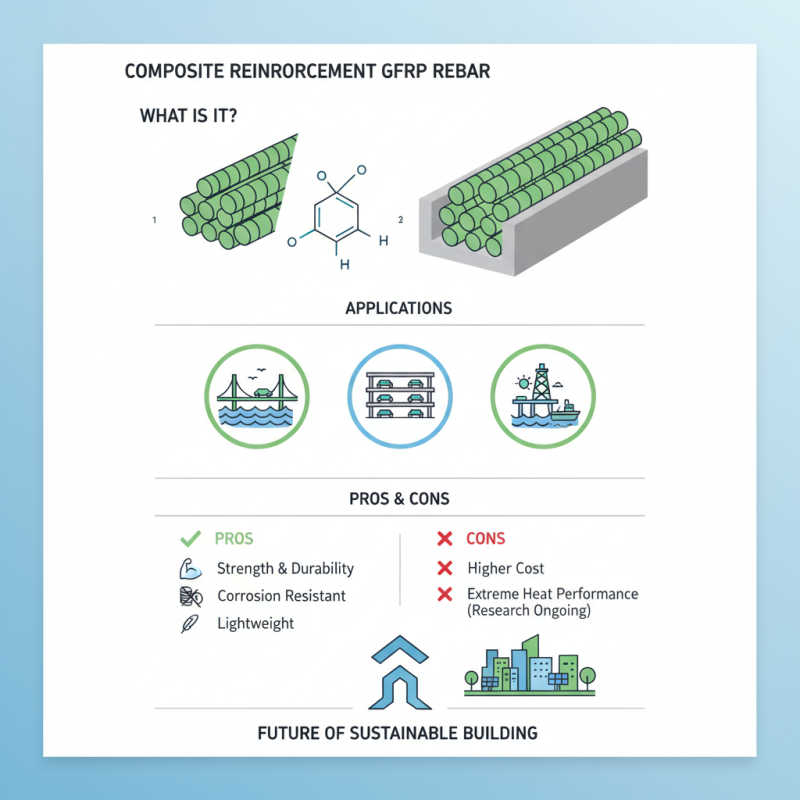
Definition and Composition of GFRP Rebar
GFRP (Glass Fiber Reinforced Polymer) rebar is an innovative construction material. It consists of a polymer matrix reinforced with glass fibers, providing unique advantages over traditional steel rebar. The composition typically includes a thermosetting resin, which binds together the glass fibers. This structure enhances durability and reduces corrosion risks, critical in harsh environments.
According to a recent report by the Global Construction Materials Market, the use of GFRP rebar is predicted to grow significantly, potentially reaching 27% annual growth over the next five years. This increase stems from the material's lightweight nature, which simplifies transportation and handling. Additionally, GFRP rebar exhibits excellent tensile strength, making it suitable for various applications, such as bridges and marine structures. However, some challenges persist; the initial cost can be higher than steel options, and industry practices are still adapting.
Existing studies indicate that the GFRP rebar performs effectively in its applications. The material is non-magnetic, a useful feature for specific engineering projects. Nevertheless, there is a need for further field data to fully understand the long-term performance of GFRP rebar in real-world scenarios. This information could bridge gaps in the knowledge base and encourage broader acceptance within the construction community.
Properties and Advantages of Composite Reinforcement
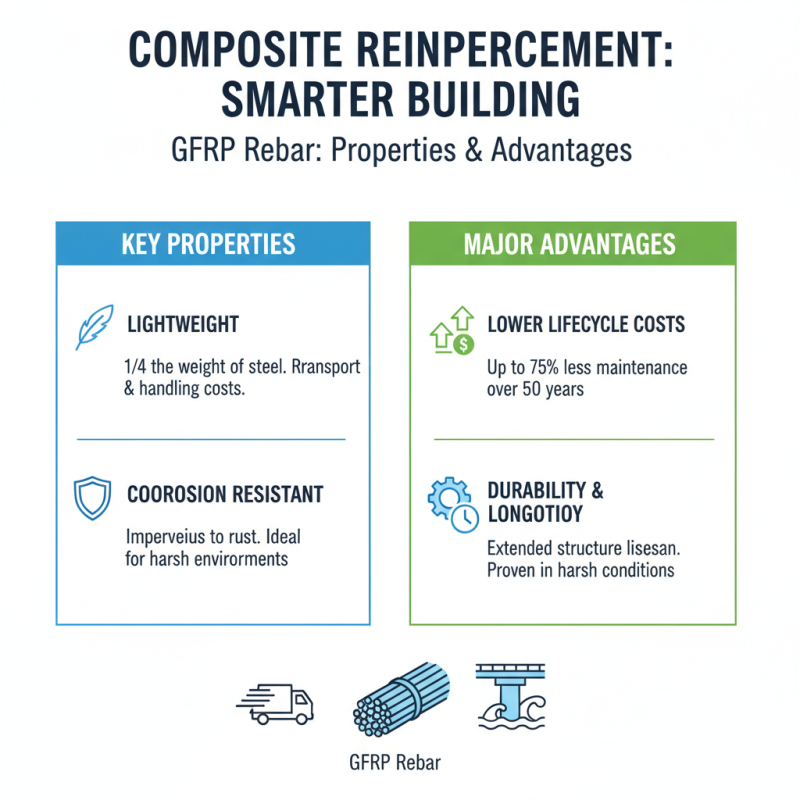
Composite reinforcement, particularly GFRP (Glass Fiber Reinforced Polymer) rebar, is gaining traction in construction. This material offers a unique set of properties that make it ideal for various applications. GFRP rebar is lighter than traditional steel, weighing only about one-fourth as much. This significantly reduces transportation and handling costs. The corrosion resistance of GFRP is another critical factor. Reports indicate that GFRP can last significantly longer in harsh environments, reducing maintenance needs by up to 75% over 50 years.
The strength-to-weight ratio of GFRP is commendable. With tensile strengths reaching up to 700 MPa, it provides excellent structural integrity. This high strength enables its use in diverse applications, from bridge decks to marine structures. Additionally, GFRP is non-magnetic and non-conductive, further expanding its use in sensitive environments. However, a challenge remains in terms of its cost. While initial investment is higher than steel, lifecycle savings can justify the expense. Understanding these dynamics is crucial for future decision-making in construction projects. The focus should be on optimizing the benefits while being aware of the financial implications.
Comparative Analysis: GFRP Rebar vs. Traditional Steel Rebar
GFRP rebar, made from glass fiber reinforced polymer, offers unique advantages over traditional steel rebar. One key difference lies in their weight. GFRP bars are significantly lighter than steel, making them easier to handle and install. This feature can reduce labor costs and make construction projects more efficient. Steel, while strong, is prone to corrosion in harsh environments, which can lead to structural failures over time.
In terms of tensile strength, GFRP rebar offers comparable performance to steel, but with less weight. This can make a significant difference in certain applications, such as bridges and marine structures. However, GFRP's brittleness is a point for reflection. In extremely high-stress situations, this material may not perform as well as steel, which can deform without breaking. The lower thermal resistance of GFRP also raises questions about its long-term durability under varying weather conditions.
The cost considerations are essential as well. While the upfront cost of GFRP may be higher, the long-term savings from reduced maintenance and increased lifespan can be substantial. However, the initial investment can be a barrier for many projects. Stakeholders must analyze these factors carefully, weighing the benefits of GFRP rebar against traditional steel options.
Applications of GFRP Rebar in Construction and Infrastructure
GFRP (Glass Fiber Reinforced Polymer) rebar is a revolutionary product in the construction industry. Its applications are growing due to its strength, lightweight nature, and resistance to corrosion. Unlike traditional steel, GFRP rebar does not rust, making it ideal for harsh environments. This offers significant advantages for infrastructure projects near saltwater.
In bridges, for instance, GFRP rebar helps reduce maintenance costs. These structures remain intact longer, especially in coastal areas. Additionally, GFRP is used in sidewalks and parking garages. Its non-corrosive properties enhance the durability of these facilities. Remember, using GFRP can lead to substantial long-term savings.
Tip: Always consult with a professional when determining the best reinforcement for your project. The specific environmental conditions and load requirements are crucial. Always prioritize quality over cost when selecting materials.
Some challenges exist with GFRP rebar, such as its relatively higher initial cost compared to steel. Professionals must weigh the long-term benefits against upfront expenses. Proper training for installation is also essential. Mistakes here can compromise the structure. Ensuring that labor is well-versed in GFRP rebar handling is vital for success.
Future Trends and Innovations in GFRP Reinforcement Technology
The future of GFRP (Glass Fiber Reinforced Polymer) reinforcement technology appears promising. Engineers and researchers are focusing on enhancing the mechanical properties of GFRP rebar. By incorporating advanced materials, the strength and durability are expected to improve significantly. This can lead to wider applications in construction and civil engineering.
Innovative techniques like 3D printing and smart sensors are being explored. They can enable the design of more complex structures that leverage GFRP's benefits. For instance, integrating sensors can help monitor the health of structures in real-time. This is crucial for ensuring safety and longevity.
However, challenges remain. The cost of production can be high for GFRP materials. Additionally, the long-term performance in various environments is still under study. Research is ongoing to address these uncertainties. Collaboration among academia, industry, and engineering firms will be vital in overcoming these hurdles.
What is Composite Reinforcement GFRP Rebar and its Applications? - Future Trends and Innovations in GFRP Reinforcement Technology
| Dimension |
Value |
Application |
| Diameter (mm) |
12 |
Civil Engineering |
| Tensile Strength (MPa) |
800 |
Bridge Construction |
| Elastic Modulus (GPa) |
40 |
Pavement Design |
| Weight (kg/m) |
1.2 |
Corrosion-Resistant Structures |
| Thermal Conductivity (W/m·K) |
0.2 |
Energy Efficient Buildings |
| Durability (years) |
50+ |
Infrastructure Repair |